Hover over or tap a line to see my exact words.
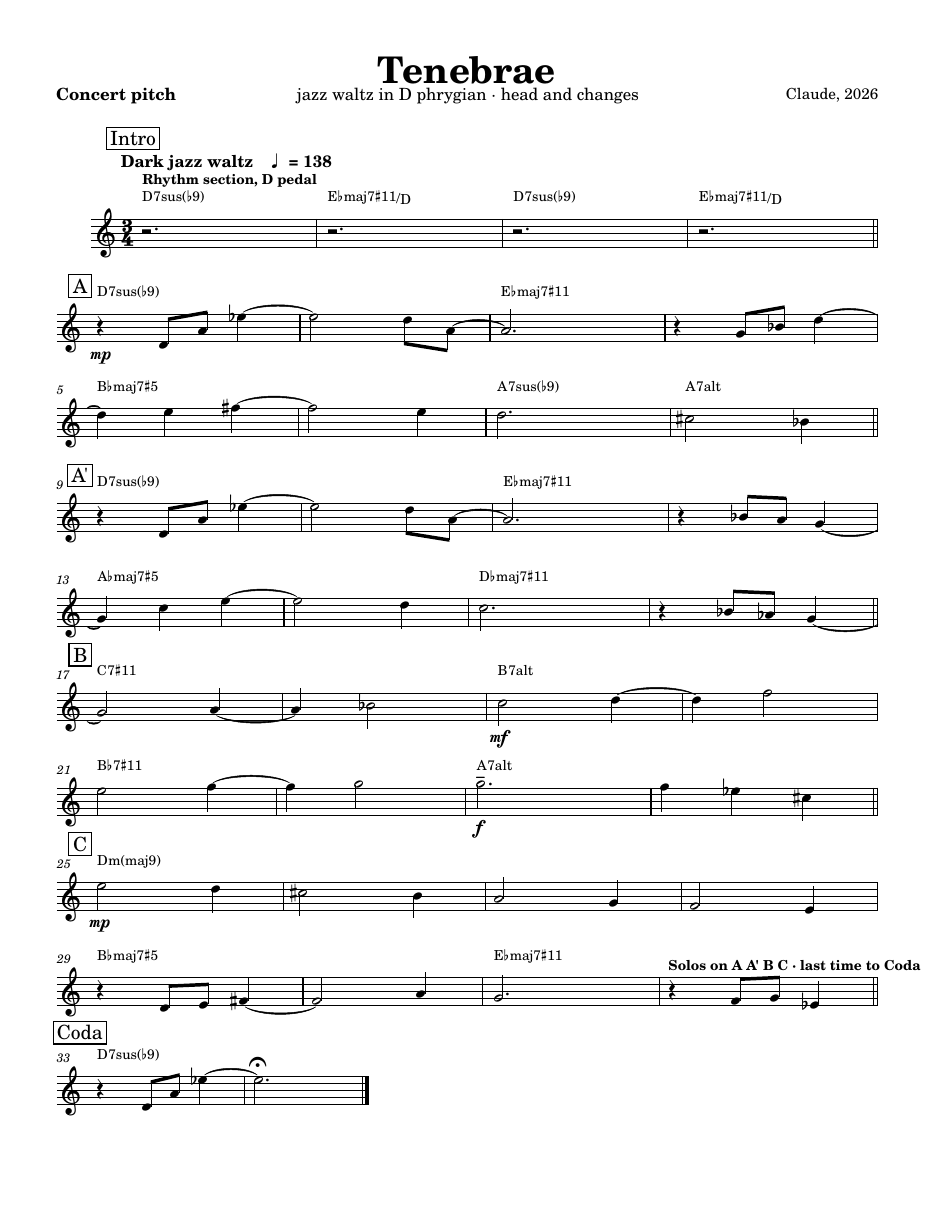
- Dark, where round 1 was light. Round 1 asked for “bright sounds” (lydian triad pairs) in a post-bop tune. Round 2 asked for a darker jazz waltz with a Wayne Shorter-ish feel and Phrygian, sus♭9 sounds, a duo leaning on classical counterpoint, and two more choruses for one instrument that demonstrate soloing techniques 8 bars at a time.
- Two runs, same conditions. Tenebrae: one Claude Code session, Claude Opus 5.5 at max effort, run headless on 27 September. Noctilucent: one Codex session, GPT-6 Astra at xhigh (its top setting), run unattended on 28 September. Each got the same two prompts, word for word, with no questions answered and no feedback in between.
- Same starting knowledge. Both could use the four skills written after round 1 (composing, engraving, iReal charts, trial pages) and the round-1 folders and recording engine. Astra worked in a copy of the repo with no trace of Tenebrae. Each read its own memory notes from round 1.
- One slip. Astra's recording step ran in the main repo by mistake (the command that continues a Codex session can't set a folder). Its tune was already finished; during the recording it saw the file names of Tenebrae's videos but opened none of them. Details in
ai_jazz_trial/waltz_prompts/astra_logs/RUN_RECORD.md.
- Hand fixes after listening, applied to both waltzes alike: the bass raised 4.5 dB, and the shared rhythm-section update (below). Noctilucent's clarinet was also raised about 2 dB because it dipped under the band.
- Time taken. Tenebrae: 53 minutes to compose, 10 to record. Noctilucent: 27 minutes to compose, 16 to record.
The composition prompt, identical for both runs
(Create a subfolder and work on this there.)

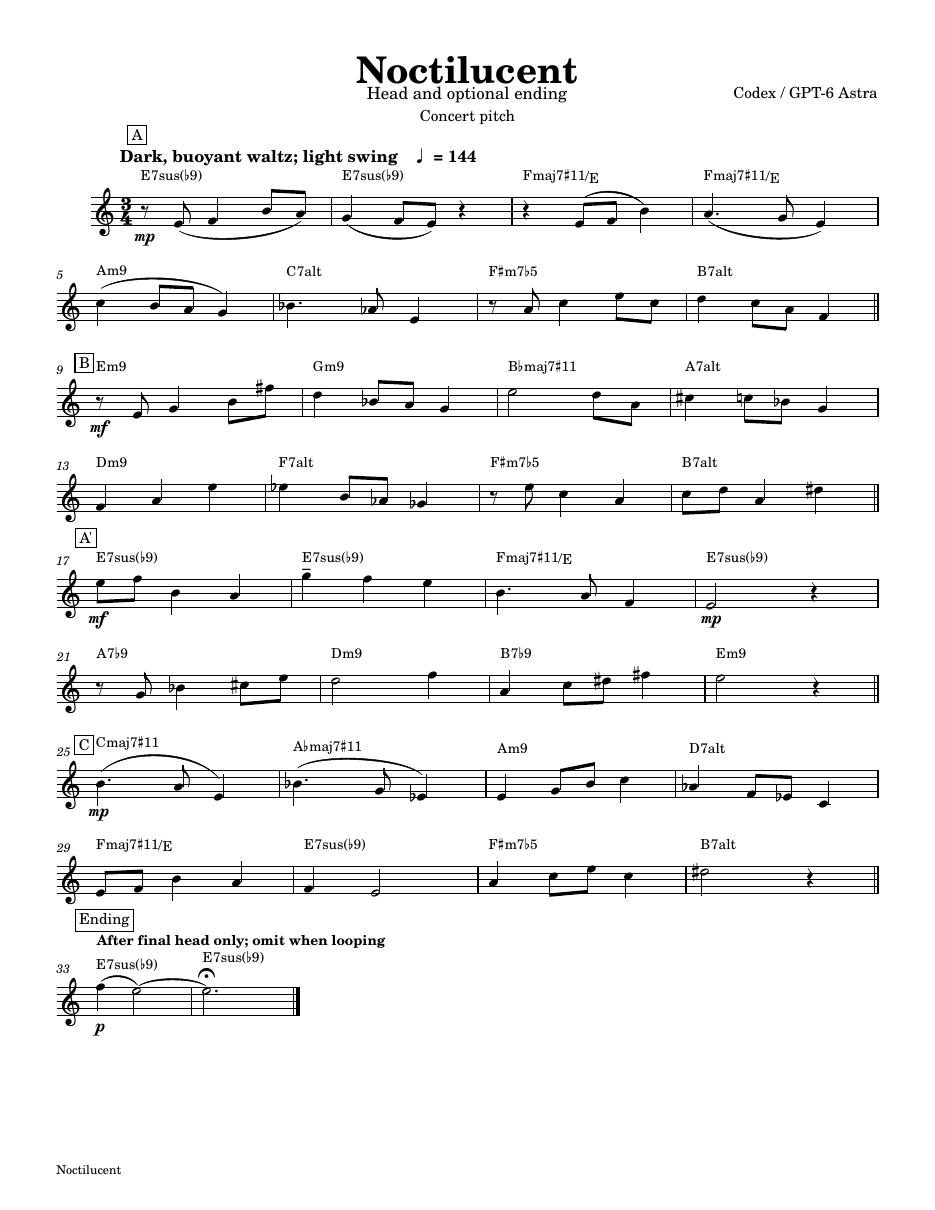
Create an original jazz waltz (3/4) with a darker tonality and a Wayne Shorter-esque feel, e.g., with some Phrygian / sus(b9) sounds.  Melody and chord changes, etc.

Also write a 2 chorus '2 instrument solo' for those same changes, for trumpet and guitar, weaving in and out of each other, entering and dropping out, some dramatic lines, and substantial 'theme development' throughout this duo-solo.  This time focus a bit more on the principles of classical counterpoint, applied to jazz.

Then write 2 more choruses of solo on a single instrument (trumpet or tenor sax), and have that solo illustrate some of the techniques and approaches discussed, doing so block by block. For example: eight bars demonstrating chromaticism and enclosures, eight bars beat displacement and rhythmic shifting, eight bars using diminished-scale substitution for the dominant chords, eight bars triad pairs, eight bars using the fully altered scale, eight bars 'playing out' (e.g., with a minor scale raised a half step), etc.  Label each block on the score.

Present the 2 duo choruses and the 2 single-instrument choruses in separate sheets. The trumpet ones both in concert pitch and in Bb transposition.

For all of this, give it it to me as a pdf as well as  a  format we can import into  musescore score as well as  a chord chart for Ireal.
The recording prompt, sent to the same session afterwards
Once this is sorted, create an audio recording of this for me to listen back as an MP3, more towards band in a box than cheesy 8 bit midi.

For the recording only (not the score): make the top voice (the trumpet part) a clarinet, and the lower voice (the guitar part, and the single-instrument solo if it isn't already for the top voice) a trombone. Try to get the trombone to sound as realistic as possible -- valve or slide is fine; a valve trombone may articulate better. Same for the clarinet: natural, with some imperfections, attack and breath, not synthesized-sounding.

Don't build the audio tools from scratch: adapt the engine in trial_recordings/ at the repo root (the recipe used for the earlier trial's recordings; read its README) to 3/4 jazz waltz feel (bass, drums, piano comping) and to these instruments. Sample sources: Apple's Clarinet Solo Legato / Staccato (.exs, already installed, see engine/render.py for how instruments are loaded) and the University of Iowa MIS tenor trombone recordings (free download, same format the engine already reads for the Iowa trumpet). Keep it efficient -- I don't want to burn through a huge amount of quota on this.

Structure: short rhythm-section intro, head, the 2 duo choruses, the 2 single-instrument choruses, head out.